Kimi AI: What It Is, What It Does and How It Compares to Claude Fable
What Kimi AI and Kimi K3 are, what they are used for, and how they compare with Claude Fable, with prompts to copy.
Kimi AI is one of the most interesting AI tools to watch in 2026, because it has become a symbol of the competition between Chinese and American AI models.
On one side are OpenAI, Anthropic and Google. On the other, companies such as Moonshot AI, Alibaba, DeepSeek, Zhipu and Qwen are growing fast. Kimi has found a clear position inside that race: long context, research, coding, agents, open models and competitive prices.
In July 2026 Moonshot released Kimi K3, which several outlets compared with Anthropic’s Claude Fable 5. Kimi is not a clear winner over Claude overall, yet the gap is narrowing, and the right choice now depends more on the kind of work you do.
Kimi AI is an assistant from the Chinese company Moonshot AI, strong on long documents, research and coding.
Kimi K3 is its flagship model, an open-weight model that competes with premium models at a lower listed price.
It still needs your judgement: check facts, review code and keep the strategy in human hands.
What is Kimi AI
Kimi AI is an artificial intelligence assistant developed by Moonshot AI, a Chinese company founded in 2023. It started as a chatbot and has grown into an environment for long conversations, online research, document analysis, reasoning, code and agent-style tasks.
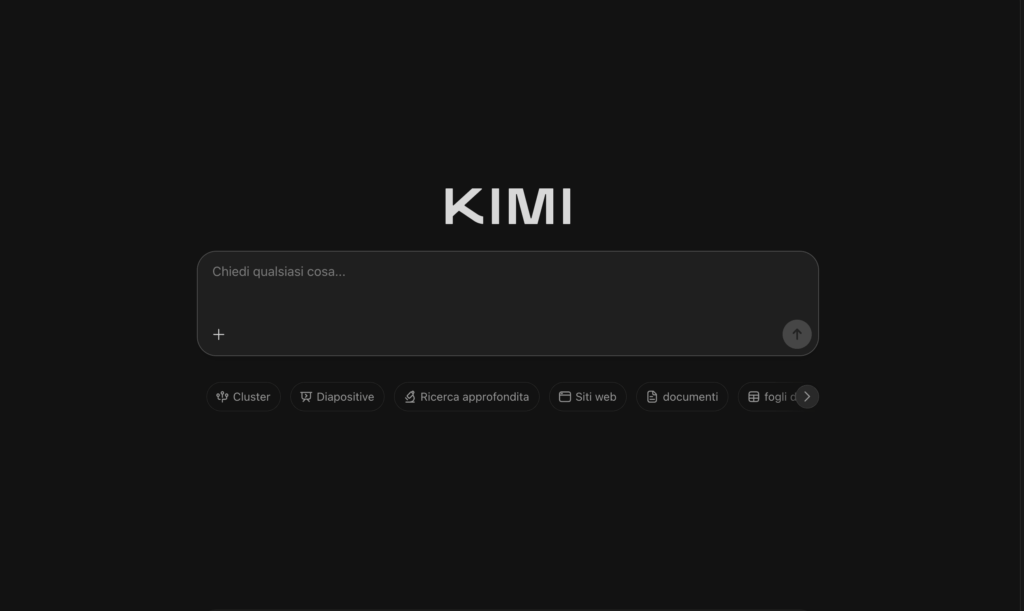
Its main strength is working with a lot of context. That helps when you have long texts, reports, PDFs, research material or a project that needs memory and continuity.
Many AI tools do well on a single question. Kimi gets interesting when the job takes several steps: read a document, pull out the key points, compare them with other sources, write a summary, then draft and improve.
What Kimi AI is used for
Kimi helps with any task where reading, summarising, research and reasoning mix. You can study a topic, analyse a PDF, compare documents, write articles, generate ideas, prepare content, work on code or research online.
The simplest use is writing: give it a topic, a goal and an audience and it drafts. The real value arrives when you give it material to analyse, such as a long report, a call transcript, a strategy document, a set of sources, a competitor’s site or a landing page to review.
For marketing this is useful with one condition. AI speeds up research and production, and the message, positioning and commercial direction stay a human responsibility.
Why Kimi AI matters in 2026
Kimi was already known for handling long context. In 2026 the conversation moved to a more competitive level with Kimi K3.
According to DataCamp and Tom’s Hardware, K3 is a large open-weight mixture-of-experts model with a context window of one million tokens, and Moonshot released its weights at the end of July 2026. Moonshot lists API prices of $3 per million input tokens and $15 per million output tokens.
Most of the benchmark results published at launch come from Moonshot itself, so treat them as company claims until independent tests confirm them.
Kimi AI vs Claude Fable: what really changes
Skip the football-match mindset and look at where each one makes sense.
Claude Fable 5 sits at the top of Anthropic’s range, aimed at difficult professional work, complex coding and long agentic tasks. Kimi K3 is seen as a strong alternative for coding, front-end work, agents and cost.
Independent comparisons give a mixed picture. One aggregator that ran shared evaluations found Fable 5 ahead on most of them, while Kimi K3 was far cheaper per token. In one coding benchmark the two were within a point and a half of each other, and Fable was described as the more reliable.
Claude Fable stays a strong choice if you want a premium model inside Anthropic’s ecosystem. Kimi is worth trying if you want a powerful, more open and possibly cheaper option for particular workflows. Versions keep changing, so check which ones a comparison actually tested.
Kimi AI for long documents
Kimi is known for handling long documents and conversations. Picture a market report, a research paper, a call transcript, a batch of emails or a technical document: with a long context you can ask broader questions and get more coherent summaries in one conversation.
Always verify. A model can skip a detail, misread a sentence or oversimplify, even with the document in front of it. For serious work, ask for references to the relevant passages and check the critical parts.
Kimi AI for online research
Kimi can also research online, which matters for fast-changing topics such as AI tools, prices, models, benchmarks, software features and advertising platforms. Relying on the model’s memory alone is risky there.
A good research prompt looks like this:
Do an up-to-date piece of research on this topic. Separate official sources, press articles and opinions. At the end give me a practical summary and tell me which data I must verify before publishing.
If you are comparing Anthropic’s models with others, see also my guide to Claude Code for marketing.
Kimi AI for marketing
In marketing, Kimi works best in research and analysis. Give it competitor pages, reviews, landing pages, articles or call transcripts and ask for patterns, objections, repeated messages, weak points and open space to differentiate.
Information alone does not sell. It has to become messages, offers, creatives, landing pages and campaigns. If you work on Meta ads, the next step is building creatives, copy, targeting, a landing page and a follow-up system, which is what my Facebook ads service covers.
Kimi AI for writing content
Kimi can help with articles, posts, emails, video scripts and newsletters. The usual mistake is to ask for a generic draft and publish it almost untouched, which gives flat content.
Give it direction: audience, goal, tone, angle, examples, structure and what to avoid. Compare these two prompts.
Write an article about Kimi AI.
Write an SEO article about Kimi AI for business owners, marketers and creators who want to know whether to use it at work. Explain what it is, what it is used for, how to use it, whether it is free and why it is compared with Claude Fable in 2026. Use a clear, concrete tone with few lists and a natural rhythm.
The first asks for content. The second gives an editorial direction.
Kimi AI for code
Kimi can explain code, generate functions, find bugs, write tests, produce technical documentation and reason about components and architecture. The comparison with Claude Fable comes largely from here, because coding is where a model creates immediate value.
Generated code must always be reviewed. A solution can look right and still introduce bugs, break compatibility or ignore a project constraint. Use Kimi to speed up your work, and keep thinking yourself.
How to use Kimi AI
The best way is step by step. First give context, then ask for analysis, then ask for a proposal, and only then ask for the final output.
For an article, start with research, then an outline, then the most interesting angles, then choose, then write. For a document, ask for a map first, then the critical points, then the operational implications. For code, ask for a plan, then the change, then the tests, then an explanation of what changed.
Kimi is more useful when you treat it as a collaborator to guide, and less useful as a vending machine for answers.
Is Kimi AI free
Kimi may offer free or accessible modes, but availability, limits and plans change often. I could not confirm current free-plan details from an official page, so check them directly when you use it.
For professional use, look at more than price: availability, limits, privacy, model quality, export options, API, speed and reliability.
Best prompts for Kimi AI
The best prompts combine an objective, context and constraints.
Research
Do up-to-date research on [topic]. Use recent, authoritative sources. Separate facts, interpretations and uncertain points. At the end give me a practical summary.
Analysing a document
Analyse this document and tell me what really matters. I want a summary, risks, opportunities, points to verify and recommended actions.
Writing an article
Write an SEO article on [keyword] for [audience]. The goal is [action]. Use a clear, concrete tone with few lists. Include practical examples, frequently asked questions and a final call to action.
Comparing competitors
Analyse these competitors and compare positioning, promise, offer, tone, proof and call to action. Then suggest three ways for me to differentiate.
Code
Analyse this code and explain what it does. Find possible bugs or maintenance problems. Before changing any file, propose a plan.
4 mistakes to avoid with Kimi AI
The first mistake is treating it as an answer engine. A vague question gets a vague reply, and then the tool looks mediocre when the prompt was the issue.
The second is skipping verification. This goes for every model. If you publish dates, prices, benchmarks, technical data or recent news, check them.
The third is producing more content without improving the message. Extra content brings no extra clients, and AI amplifies a weak positioning or a confused offer.
The fourth is comparing tools without a use case. Test them on real tasks: your document, your code, your landing page, your research.
AI speeds up research and writing, and results still come from a clear offer and campaigns that reach the right people. A food e-commerce store went from about £2,580 to about £4,950 in one month by changing how its Facebook ads were set up (read the case study).
If you want that kind of work done for your business, see my Facebook and Instagram ads service.
Is Kimi AI worth it
Yes, if you often work with long documents, research, analysis, code or complex content. It makes less sense if you only want a generic chat for quick questions, where many tools will do.
Conclusion
Kimi AI shows how crowded the top of the AI market has become. It is a serious option for long-context work, research and coding, and the best way to judge it is to test it on your own tasks.
If you want your marketing built on a clear message and run by someone who tests these tools daily, you can start with a freelance copywriter or with Facebook ads management.

Frequently asked questions about Kimi AI
What is Kimi AI?
Kimi AI is an AI assistant developed by Moonshot AI, a Chinese company founded in 2023, known for long context, research, document analysis and coding.
What is Kimi K3?
It is Moonshot’s flagship model, released in July 2026 as an open-weight model with a context window of one million tokens.
Is Kimi AI better than Claude Fable?
Not in every case. Independent comparisons give a mixed picture, with Fable 5 ahead on most shared evaluations and Kimi K3 much cheaper per token, so test both on your own tasks.
Is Kimi AI free?
It may offer free or accessible modes, but limits and plans change often, so check the current conditions before relying on it for work.
What is Kimi AI good for?
Long documents, online research, analysis, writing content and code, especially when the work takes several steps.
Can I trust what Kimi AI writes?
Treat it like any AI model: verify facts, dates, prices and benchmarks, and review code before using it.
Want a marketing partner who tests these tools every day?
Tell me about your business on WhatsApp. I reply personally, and we look at your numbers together.
Talk to me on WhatsApp →